
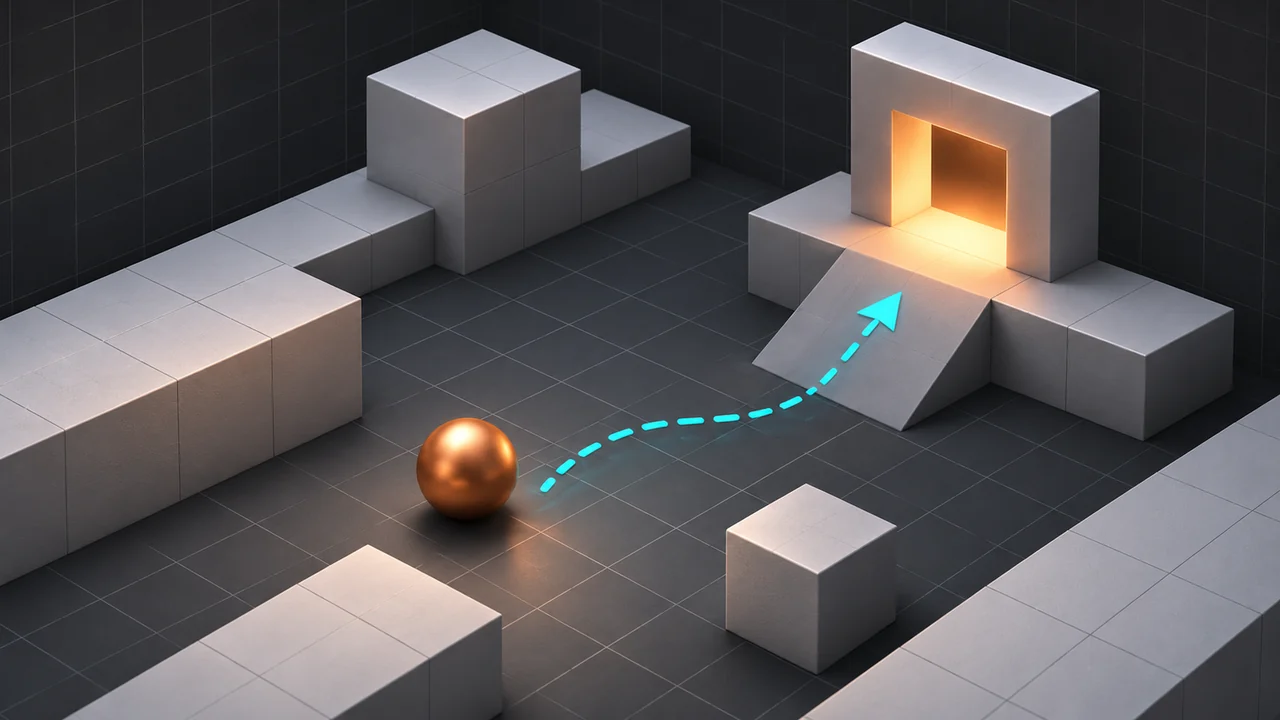
A polished scene can make an idea feel further along than it is. Good lighting, a finished character and a convincing menu tell you that the presentation is working. They do not tell you whether the player has an interesting decision to make.
A prototype is useful when it helps you answer a specific question before you commit to the surrounding work. The following approach is a practical starting point, rather than a required sequence for every genre.
Start with a question you can test
“Is this game fun?” is too broad to guide the next task. Try a question that names the interaction and the uncertainty: can a player judge a jump after a short charge, or does choosing between two delivery routes create a meaningful trade-off?
For a hypothetical jumping game, you might test whether holding and releasing one button gives players enough control to land on a moving platform. That question needs a controllable character, a platform and a way to restart. It does not need an inventory or a world map.
Write down what you expect to observe. If players cannot tell when to release the button, the next iteration should explore timing feedback or control changes. Adding a second level would leave the same question unanswered.
Build only the part that carries the answer
Simple shapes are often enough for movement, collision and timing experiments. Use consistent scale and readable contrast so that missing art does not obscure the interaction you are trying to judge.
Temporary assets still need to communicate their purpose. A hazard that looks identical to safe ground makes a test difficult to interpret. A plain red block and a clear impact sound can be more useful than an elaborate effect whose meaning is uncertain.
Decide what the test can safely omit. For the jumping example, a reset key may replace a full menu. A short instruction can explain the one control. The player still needs a clear goal and an obvious result after a failed attempt.
Match the prototype to the risk
Grayboxing is useful for space and movement. It is less useful when the main uncertainty is the tone of a conversation, the readability of a crowded interface or the feel of a musical interaction.
Choose the smallest representation that preserves the thing you need to learn. A paper sequence may reveal a confusing choice structure. A rough interactive dialogue can test pacing. An audio experiment may need representative sound earlier than a movement test needs finished textures.
This is also where presentation can belong in a prototype. If recognising silhouettes is central to the game, a test with identical cubes will not answer that question. Temporary should mean economical and replaceable, not unsuitable.
Keep the comparison understandable
Change one important variable at a time when you want to compare alternatives. If you alter the jump force, camera, platform speed and input delay together, you may like the new version without knowing which change helped.
Keep a short record of each build: the question, the change and the observation. For example, “The landing marker was visible, but the player watched the character instead.” That observation suggests a follow-up test; it does not yet prove that the marker should be removed.
Save a working version before experimenting. A source-control commit or a clearly labelled copy gives you a way back when an alternative makes the interaction harder to understand.
Let someone else try it
Explain the goal of the session without teaching the solution. Watch whether the player understands the control, recognises success and can recover after a mistake. If you have to narrate every step, record the places where you intervene.
Ask about a particular moment afterwards: what did they expect when they held the button, and why did they choose that platform? Specific questions are easier to connect to a design decision than a general request to rate the whole idea.
A short test with a few people can expose problems, but it cannot establish broad demand or guarantee retention. Use what you observe to choose the next experiment, and distinguish an interaction problem from a technical failure in the build.
Decide what happens next
Finish the experiment with a decision: revise the interaction, test a different approach, proceed with a bounded version, or set the idea aside. A prototype that convinces you to stop can still have saved a great deal of production work.
Before moving on, list the assumptions that remain. A satisfying jump in one room says little about an hour of level progression. You can preserve the useful result while planning a separate test for the next uncertainty.
Unity's Creative Core course includes planning, grayboxing and testing a prototype. It is a useful guided exercise if you want to practise that process in an engine.